
-
AbstractDownload
02.03.2026
Webinar Comparison of the CYD and YPS Methods for Displacement-Based Design
Altin Suli, prix master ETHZ 2025
Modern seismic design is increasingly shifting from force-based approaches to performancebased methods that directly control structural deformations. Displacement-Based Seismic Design (DBSD) uses deformation demand as the primary design parameter and therefore better reflects observed damage mechanisms in reinforced concrete structures.
This thesis investigates two DBSD methods that rely on the yield displacement as a key control parameter: the Yield Point Spectrum (YPS) method and the Constant Yield Displacement (CYD) method. Both methods assume that the yield displacement remains stable throughout the design process.
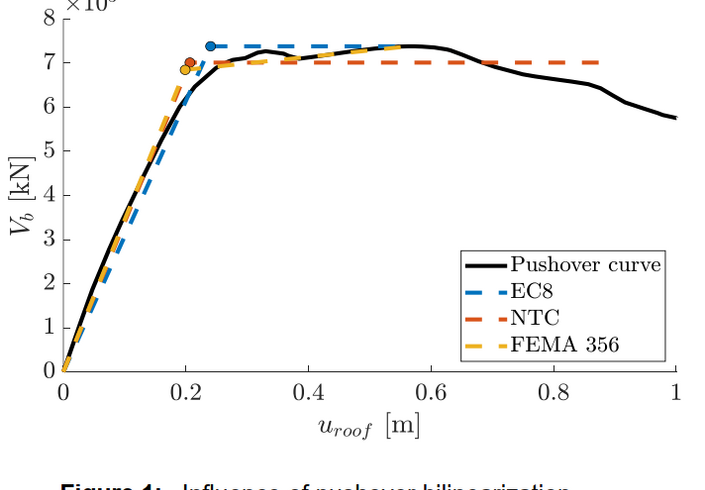
The approaches are applied to two reinforced concrete case studies: a 4-story moment-resisting frame and a 7-story cantilever shear wall designed according to EC8 using different lateral force distributions. Nonlinear static pushover analyses with fiber-based plastic hinges are used to assess convergence of yield displacement, base shear demand, and sensitivity to modeling assumptions. Results show clear convergence of yield displacement over design iterations and nearly identical strength demands from the YPS and CYD methods, with base shear differences below 0.5%.
The consistency of the results was observed for both structural systems and across different bilinearization procedures. While yield displacement is sensitive to stiffness assumptions and bilinearization procedures, the results support its use as a stable and reliable control parameter in displacement-based seismic design, highlighting the robustness and practical applicability of yield-based design frameworks.