2.12.2025, 12h00-13h00
Webinar
Lucas Kuhn
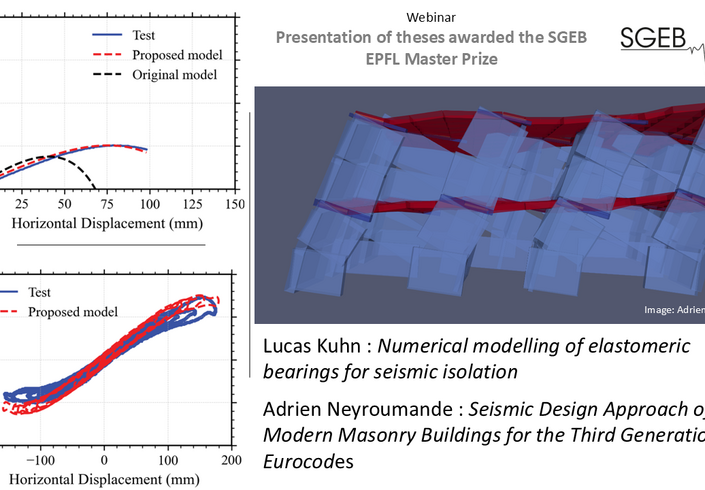
Numerical modelling of elastomeric bearings for seismic isolation
Seismic isolation bearings are critical in protecting structures from earthquake damage. An accurate modelling under earthquake loading conditions, is key to ensuring structural safety. Therefore, a numerically efficient model that captures well the shear behaviour under large displacements and large axial loads due to earthquake loading is essential. This thesis proposes a new model to improve the modelling of the shear behaviour and support rotation effects of elastomeric bearings in the framework initially developed by Kumar et al. The proposed model has been validated using 1D monotonic shear tests under constant support rotations and constant axial load. Furthermore, the model has demonstrated the ability to predict hysteretic shear behaviour under 1D dynamic loading.
Thesis supervised by Prof. Dimitrios Lignos, RESSLAB, EPFL
.
Adrien Neyroumande
Seismic Design Approach of Modern Masonry Buildings for the Third Generation of Eurocodes
Unreinforced masonry buildings are highly vulnerable to seismic action, and their nonlinear behavior is commonly represented in design through behavior factors (q) that reduce elastically computed forces to account for nonlinear effects like energy dissipation and overstrength. This thesis reproduces and extends a reference study by Butenweg et al. for Eurocode 8 by developing new building models that use Vanin et al.’s macroelement approach to represent the nonlinear behavior of masonry piers. Behavior factors are derived from both nonlinear static pushover and dynamic analyses on 28 modern URM buildings. following the latest recommendation of Eurocode 8. Pushover-based behavior factors obtained closely match those from the original study, while dynamic analysis produces behavior factors at least 25% higher, indicating the potential influence of higher-mode effects and complex nonlinear mechanisms.
Thesis supervised by Prof. Katrin Beyer, Dr. Savvas Saloustros and Ernesto Inzunza Araya, EESD, EPFL